.png)


PROJECT DETAILS
NAME : CAFE MERAKI
LOCATION : RANCHI, INDIA
CATEGORY : CAFE INTERIOR
STATUS : COMPLETED
BUILT AREA :1600 SQFT
DESIGN BRIEF
For the clients, the brief was layered with emotion and ambition. Having nurtured their brand through years of loyal patronage, they aspired to create a culinary space that could speak to a younger, more diverse audience—without alienating long-standing patrons. “We wanted to create a soothing space, but not something monotonous. Every corner needed to feel different,” reflects Ankit. This intent toward multiplicity—of moods, experiences, and encounters—became central to the cafe design.
DESIGN PHILOSOPHY
To design a cafe in the dense, kinetic heart of a city is to negotiate between pause and bustle, and this cafe design embraces that balance. In Ranchi, Cafe Meraki emerges as such an exercise—an architecture of calibrated calm suspended above urban flux. Perched on the first floor of a commercial building owned by Gupta Rolls, a beloved food joint with over two decades of legacy, this 1600 sqft space marks an evolution from quick-service familiarity to experiential dining. Conceived by APDL, under the principal stewardship of architect Ankit Berry, the project reimagines a commercial volume into a contemporary social landscape.
Palette, form and spatial language
The resulting spatial narrative harbours a restrained yet expressive palette. Shades of terracotta, blue, and green are interspersed with grey and anchored by expanses of white, establishing a nuanced chromatic balance. This limited vocabulary allows materiality and form to assume greater prominence. Solids and voids converse across the interior, manifesting in gently curved partitions, recessed niches, and arched apertures.
Micro-environments within a compact plan
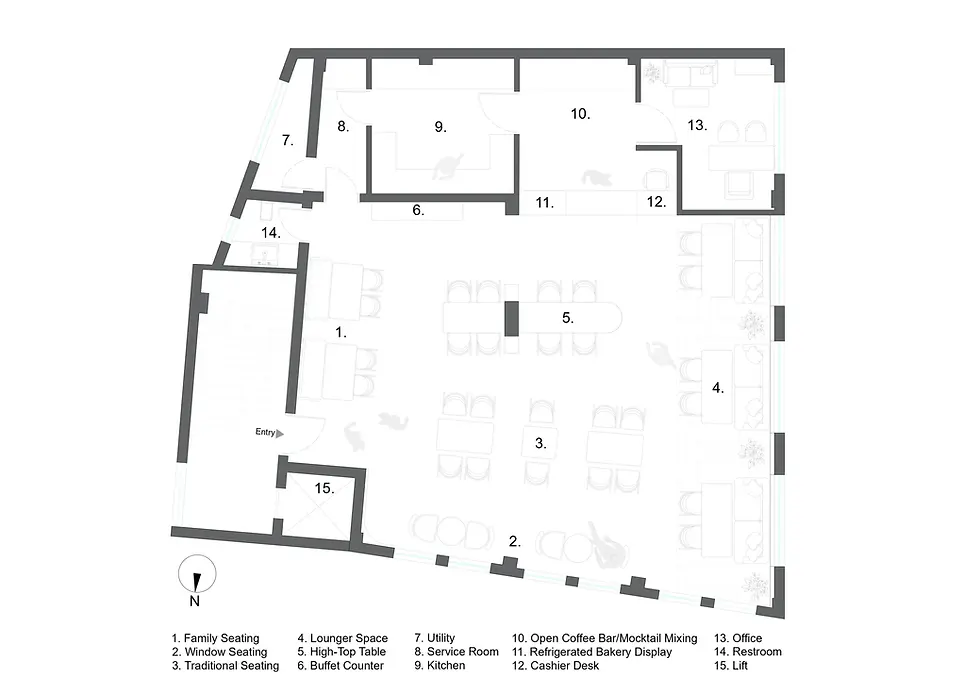
Within the compact envelope, seating and circulation were resolved through meticulous spatial planning. “We kept thinking—where would a couple sit on a date, where would a family feel comfortable, where would Gen Z want to gather,” says Ankit. The space thus unfolds as a mosaic of micro-environments, accommodating varied social experiences across 42 seats.
Responding to climate and context
Environmental responsiveness further shaped the design. On the west, adjustable blinds temper sunlight and heat. To the north, the proximity of a flyover posed challenges of noise and wind. Instead of retreating inward, the architect recalibrated the interface. Three oblong windows were dismantled and replaced with enlarged arched openings that soften the facade, moderate noise, and frame glimpses of the city beyond.
Material warmth and crafted details
Teakwood chair frames bring tactile warmth, while bespoke tables—crafted on site with tiled tops resembling a stone finish—reinforce material consistency. Stone paver tiles ground the lounge area, while light-grey tiles delineate other zones. The absence of a false ceiling reveals an unvarnished spatial volume, with services discreetly concealed using fine landscaping wires that render conduits almost invisible. What remains is an uncluttered overhead plane that enhances vertical generosity.
Zones, textures and visual anchors
The lounge area, anchored by the chromatic continuity of a tan-hued sofas and backwall, exudes relaxed indulgence. Opposite, the family seating area is set against a textured grey canvas achieved through layered two-tone paint treatments that mimic limewash. A mint-green drywall partition delineates the kitchen while doubling as an accent wall that cradles curated artefacts. Framed wallpaper remnants—repurposed from other ongoing projects—compose an installation alongside potted greenery that enlivens the milieu.
Details that define character
An existing structural column, positioned inconveniently at the centre of the plan, is reimagined as a bookshelf and spatial mediator, that gently separates stool seating from regular dining. Elsewhere, the barista counter asserts itself as a visual anchor, its facade clad in dual-toned blue Kit Kat tiles for added depth. From profile strips to furniture-integrated fixtures, layered lighting supports shifting moods. Rattan pendants from Hasthshilp Udyog—an award-winning collective of rural women artisans from within Jharkhand— introduce organic texture, echoed in the woven rattan backs of select furniture pieces. Together, these elements allow the cafe to transition seamlessly from daylight conviviality to evening intimacy.
Speed, precision and functionality
Perhaps most remarkable is the project’s gestation period. Conceived and executed within an ambitious six-week timeframe, Cafe Meraki stands as a testament to disciplined design thinking. “We kept the process minimal but meticulous,” notes Ankit. “Nothing unnecessary made its way into this space.” Even within these constraints, the architect accommodated an internal office—an important inclusion for clients who, despite years in the food business, had never possessed a dedicated workspace. Integrated discreetly within the plan, it reflects the project’s sensitivity to operational realities.
A lived-in destination
In translating legacy into language, limitations into creativity, and commerce into community, Cafe Meraki emerges as more than an expansion. Today, the dining destination thrives as a lived-in, loved-in environment—animated by conversations, quiet moments, and returning patrons.